Tuesday, 23 August 2016

God’s Plan for your Life 1: Do You Know It?

God the ArchitectAre you one of those many Christians who has asked what exactly is God’s plan for my life? What do you think of when you hear those words, 'God's plan for your life?' Maybe you think everyone else has got this sorted but you have missed out. Where does this idea of God having a plan for your life come from?

''I know the plans I have for you,' declares the LORD, 'plans to prosper you and not to harm you, plans to give you hope and a future.'' (Jeremiah 29:11)

Our local Christian bookshop manager – who does understand this verse – assured me she can sell about anything in the shop if it carries this text, they just fly off the shelf. Near the bookshop is one of those generic stalls that sells New Age trinkets and junk, from a lucky cat, through fairies and angels, to Buddha in repose. Its the sort of thing people have in their home to feed their wishful thinking. Wouldn’t it be nice to have a life as serene, magical, lucky.

Life is never as serene as Buddha sitting under a Bodhi tree, angels and fairies don’t sit on your shoulder to grant wishes, and cats are – cats. Jeremiah 29:11 is to many Christians what the lucky cat is to the wishful thinkers, comforting to contemplate but of no practical use. This is one of the most misunderstood and misapplied texts in the Bible and Christians could save themselves a lot of trouble and troubled introspection if they understood it..


Context

Jeremiah 29:1-2 tells us the context is the exile of Judah, including Daniel and his companions. The verse comes in the text of a letter sent by Jeremiah from Jerusalem to exiled Judah. The 'you' of verse 11 is plural, the promise of v.11 is very specific in those to whom it is being made, the exiles. If it is for us at all it is plural and for the church, not for the individual. Heaven preserve us from post-modern individualism - Context people.

Further, if you want Jeremiah 29:11 to be a promise to you, you must also have the previous 28 chapters, because they lead up to and contextualise the verse. They are full of warnings and exhortations, accusations, threat of drought, condemnation, and judgement. It isn't pretty. One example is 16:1-4. Look it up and ask yourself if you still want to enjoy the promises of God through Jeremiah – Context people.

Jeremiah 29:11 is not about God's perfect plan for your life but about restoration of a rebellious people after 70 years in exile. Context again.

God had miraculously brought Abraham's descendants out of the house of slavery and commanded them 'now live like this,' giving them the Law through Moses. The Law didn't bring people to God, God brought people to himself then gave them the Law - Exodus 19:3-6. The Law describes how a saved people live. I say again Context.

Leviticus 26:14-15, 31-33 describes what God will do if his people reject his Laws and violate the covenant. Terror, disease, fever, hunger and defeat at the hands of enemies, terror, ruin, waste, scattering and exile. Context teaches us.

Leviticus 26: 39-42 describes how God will, nevertheless, keep his promises and restore his people, 'Then I will remember you...For I know the plans I have for you...' Lev.26:42; Jer.29:11) God's plans are never thwarted. Context is understanding.

Even though we might take comfort from the general understanding that we are in God's hands and care - In all things God works for the good of those that love him' Ro.8:28 - we cannot reasonably apply Jeremiah 29:11 to us. It is an example of what has come to be known as narcisegesis, the unbiblical habit of making all Scripture revolve around me.

If God doesn't have a plan specific to my life what does he have? Is there a plan at all?


God’s Plan and Purpose

In his letter to the church in Ephesus Paul tells how God, through Christ, has blessed us in the heavenly realms with every spiritual blessing (1:3); chosen us to be holy and blameless (1:4); predestined us to be adopted as sons (1:5); redeemed us through the blood of Christ (1:7); lavished on us grace, wisdom and understanding (1:8). We are not meant to be mere creatures but sons. Sons who understand and, in understanding, exercise wisdom. No surprise since we were made originally in the image and likeness of God, to have dominion (Genesis 1:26) to understand and steward the world in which we live. All this, Paul insists, is, ‘to the praise of [God’s] glorious grace’ (1:6)

Paul explains explicitly the purposes of God, revealed to all who trust in Christ:

‘And he made known to us the mystery of his will according to his good pleasure, which he purposed in Christ, to be put into effect when the times will have reached their fulfilment-to bring all things in heaven and on earth together under one head, even Christ.’ (Ephesians 1:9-10)

The thought here is that everything that fails to make sense in this world will be summed up and given perfect meaning in Christ. Its not about me, its about Christ! Everything about us, our being chosen and predestined, serves God’s purpose and plan in Christ, ‘for the praise of his glory.’ (1:11-12) Do yourself a favour and read Ephesians 1:3-14 and count the number of times ‘in Christ’ or a variant thereof appears. It is all about Jesus, and once you realise this your doctrinal understanding will be revolutionised.

God may yet have a specific purpose for particular individuals, at particular times, in church service, mission, etc. For some it is a lifetime call. But what does a purposeful Christian life look like when there isn't a specific 'plan for my life?' We will look at that next time.

Monday, 27 June 2016

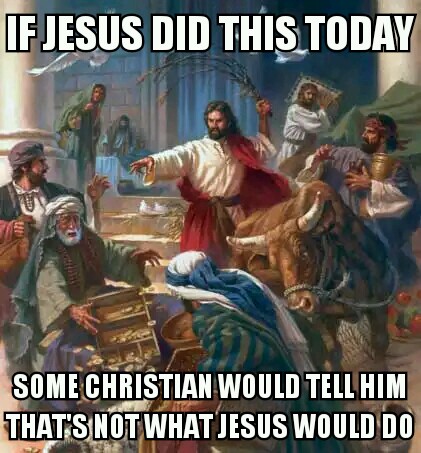
Jesus Wasn’t ‘Nice’

Every generation, every culture, shapes Christianity to reflect that culture's concerns. In Europe in the second millennium, it seemed to be very political as kings and popes, people and priests fought over power, property, and the question of who governs. In South-East Asia today we see Christianity being about enduring under the yoke of persecution and oppression. In South America since the 1960s it has been about Liberation Theology as the church, once again, becomes politicised as a social movement.

In the United Kingdom it seems this tendency expresses itself in niceness. Whatever the cause, however engaged with the issues we might be, however we might disagree, lets not be unpleasant, lets be nice about it. The referendum that has just passed has people in its grip and they are engaged with politics in numbers not seen in my lifetime. We fall into three categories. Those delighted with the result, those disappointed with the result, and those confused by what just happened.

While feelings are running high, many are insisting there is virtue in being a good loser, as though this is a game of table-top football. They 'regret' the unbridled language used in claims and counter-claims, insisting the right response is niceness, especially if you are a Christian. 'Lets not allow things to get out of hand,' they insist. 'We don't want any unpleasantness.' Then they reach for the kettle, break open a fresh pack of rich tea biscuits and, 'tea anyone?'

Niceness is not, however, a fruit of the Spirit. There is, 'love, joy, peace, patience, kindness, goodness, faithfulness, gentleness and self-control.' (Galatians 5:22) but I don't see niceness in there. I can have love, experience joy, show kindness, pursue goodness and faithfulness, be gentle and self-controlled and still be forthright and outspoken in pursuit of what I regard as right, just, and good, still challenge what is wrong, unjust, and evil.

New Testament figures were many things but nice wasn't one of them.

'John said to the crowds coming out to be baptised by him, 'You brood of vipers! Who warned you to flee the coming wrath? produce fruit in keeping with repentance.' (Luke 3:7-8) I don't think John was 'nice' and nor do I believe he would have been impressed with the response, 'OK John, we will try to be nicer.'

Confronted with the hypocrisy of the religious leaders of his day, Jesus said, 'Woe to you, teachers of the law and Pharisees, you hypocrites! You are like whitewashed tombs, which look beautiful on the outside but on the inside are full of dead men's bones and everything unclean. In the same way, on the outside you appear to people as righteous but on the inside you are full of hypocrisy and wickedness...You snakes! You brood of vipers!' (Matthew 23:27-33) I don't imagine the disciples saying, 'That's so rude Jesus! Why can't you be nice?'

In refuting the Jewish Christians who wanted to circumcise Gentile Christians the apostle Paul wrote, 'Mark my words! I, Paul, tell you if you let yourselves be circumcised Christ will be of no value to you at all...I wish those who unsettle you would emasculate themselves!' (Galatians 5:2&12) I don't hear anyone saying, 'Really, I don't see surgery as the answer Paul. Can't we sit and talk about this over a cup of tea?'

When Simon the Sorcerer offered to buy from Peter and John the power to endow spiritual gifts, the apostles didn't say, 'You know, there's been a misunderstanding here. Put the kettle on and we'll talk about a preaching series in the Autumn.' No! 'Peter answered, 'May your money perish with you, because you thought you could buy the gift of God with money! You have no part or share in this ministry because your heart is not right before God. Repent..!'' (Acts 8:18-22)

In writing to the church in Sardis, Jesus says, 'I know your deeds; you have a reputation of being alive, but you are dead. Wake up!' (Revelation 3:1-2) John on Patmos, who wrote and delivered these messages, didn't say, 'That's a bit harsh Jesus. Can't we talk about this over coffee and cake?'

Jesus healed the sick, made the blind see, and the deaf hear, raised the dead, loved children, stood with the disaffected, returned dignity to ordinary people, preached hope and the need to pursue virtue and goodness. He also challenged the rich and the powerful, fought against injustice, shamed hypocrisy, spoke out, stood out, called out and confronted all that is evil in this world. Nice people don't do that. But then, Jesus wasn't nice.

Tuesday, 9 February 2016

A Week On The M4


It occurs to me that making progress through the typical week is rather like a journey on the M4 motorway. I traveled from Swansea to London recently, along the M4, and contemplated this thought as I journeyed.

Image result for Swansea

Monday is like leaving Swansea after a restful weekend, like setting out on your journey. Duty and adventure call and, although you look back longingly at home and a warm bed, you travel with purpose and perhaps some degree of reconciliation. This simply has to be done.

Image result for Newport

Tuesday is rather like Newport. You feel as though you have already come such a long way but there is yet so much further to go. A sense of resignation sets in as you accept there is no turning back.


Image result for severn bridge

Wednesday is like arriving at the Severn Bridge. Surely this is a major stage on your journey, signalling real progress made. Of course, the other side of the bridge is England but, as my mother used to say, you can't have everything and, while the road actually rises from the bridge, you feel as if the hardest part is behind you and you are on the downward ride to your destination.

Image result for Swindon


Thursday is like Swindon. Here is where reality kicks in and reminds you that, despite your effort and perseverance, there is yet some distance to travel. Like someone popping into the pub Thursday evening for a drink and to find consolation with fellow travelers, you pull into the Leigh Delamare service area for a much needed break.

Image result for Reading Service area M4


Friday is like the Reading service area. There is a real sense of an end in sight. Soon you will see the familiar signs for Heathrow Airport and you eagerly count down the last few junction numbers. But this part of the motorway proves much busier than at your starting point. People are driving faster, more erratically at times. It is just like a Friday afternoon when the weekend is in sight yet there is still much to before you can to walk away from work and enjoy your destination in peace.
Image result for London


The weekend is like London, your destination and, just like visiting any big city, there are highs and lows, bright lights and dark corners. The weekend, like the city, has its attractions and distractions, fulfillment and disappointment, but seldom lives up to its reputation. The weekend is, in anticipation, more than it is in its in realization. It brings rest, recuperation, and hopefully a fresh resolve to make better of things but, come Monday morning...